Water safety is not simply about knowing how to swim. It is about understanding risk, recognising changing conditions, making responsible decisions, and knowing when to act.
Through its ongoing water-safety education initiatives, the Maldives Swimming and Life Saving Skills Training School (MSLSTS) promotes a fundamental principle:
Prevention begins with awareness.
Awareness Is the First Line of Protection
Aquatic incidents can develop within seconds. A person may enter the water confidently, environmental conditions may change unexpectedly, or a seemingly routine situation may rapidly become hazardous.
Effective water safety therefore depends on continuous awareness, active supervision, sound judgement and early action.
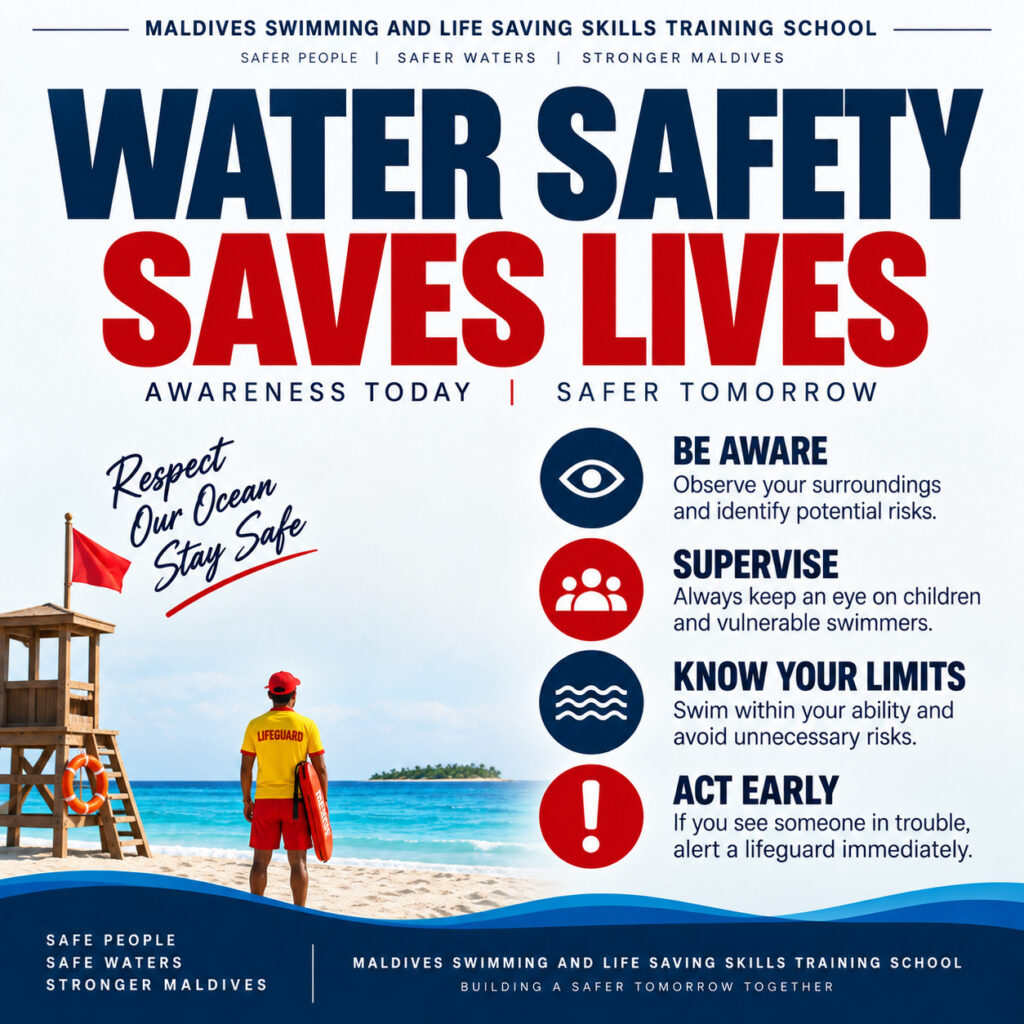
Five fundamental principles should remain at the centre of every safe aquatic environment:
1. BE AWARE
Understand your surroundings.
Observe the water, weather, currents, hazards, visibility and the behaviour of people around you. Recognising hazards early creates an opportunity to prevent an incident before it becomes an emergency.
2. SUPERVISE
Children and vulnerable swimmers require active and continuous supervision.
Being physically nearby is not the same as maintaining effective supervision. Attention must remain focused on the person or area being monitored, with distractions minimised.
3. KNOW YOUR LIMITS
Your swimming ability, physical fitness, experience and the surrounding environment all influence your level of safety.
Entering water beyond your capability can quickly transform a recreational activity into a life-threatening situation.
4. ACT EARLY
Early intervention can prevent escalation.
If someone appears to be struggling, behaves unusually, enters an unsafe area or may be at risk, raise the alarm and seek assistance immediately.
Do not wait for a situation to become an emergency before taking appropriate action.
5. RESPECT THE ENVIRONMENT
The aquatic environment is constantly changing.
Waves, currents, wind, weather, visibility, tides and other environmental factors can significantly affect safety. Understanding and respecting these conditions is an essential part of responsible water use.
From Knowledge to Action
Water-safety education should not end with awareness.
Knowledge becomes meaningful when it influences behaviour.
For lifeguards, this means maintaining disciplined surveillance, recognising subtle changes in behaviour, identifying environmental hazards, maintaining effective positioning and remaining prepared to respond.
For swimmers, guests, families and communities, it means following safety guidance, using designated swimming areas, supervising those who require assistance and seeking help whenever conditions become unsafe.
A Shared Responsibility
Creating safer aquatic environments is not the responsibility of lifeguards alone.
It requires cooperation between individuals, families, communities, hospitality professionals, aquatic operators and safety teams.
A strong water-safety culture develops when people understand that prevention is a shared responsibility—and that every person has a role in reducing aquatic risk.
“Awareness today creates safer waters tomorrow.”
The Maldives Swimming and Life Saving Skills Training School (MSLSTS) remains committed to strengthening water-safety knowledge, promoting responsible aquatic behaviour and supporting a culture in which education, prevention and preparedness come before emergency response.
