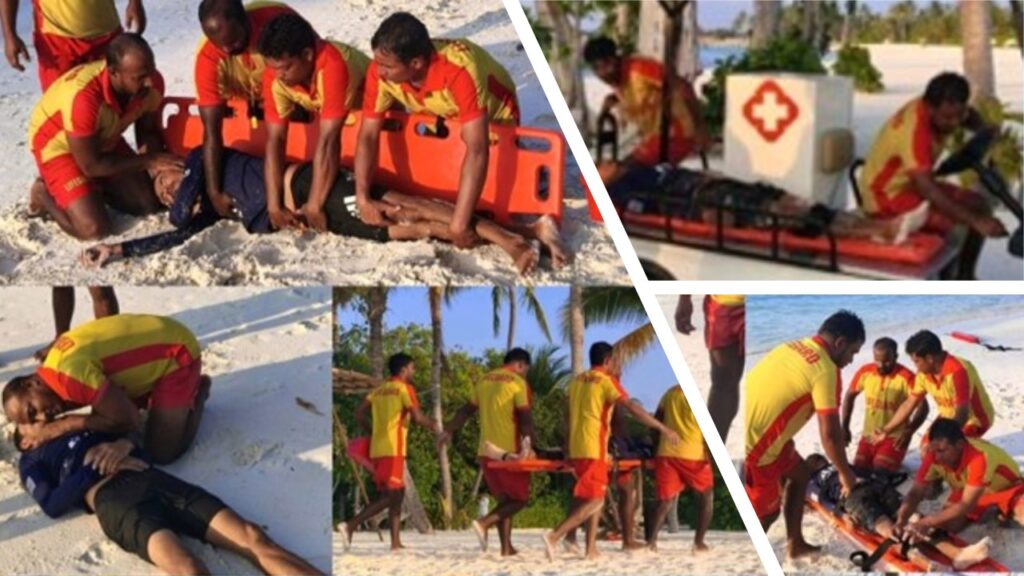
In the Maldives, geography governs emergency response. A resort island may sit an hour or more by speedboat from the nearest hospital, and seaplane transfer is available only in daylight. There is no neighbouring rescue service to call upon and no ambulance to summon. Whatever capability exists on the island at the moment of the incident is the whole of the capability available.
Drowning is unforgiving of delay. Hypoxic injury progresses within minutes, and survival with intact neurological function depends largely on how quickly ventilation and circulation are restored at the scene. Where outside help cannot arrive inside that window, the resort must act as the definitive care provider for the critical first phase. The most persistent gap in resort preparedness is the absence of incident command, largely because it is confused with response management. Response management belongs to the lifeguard: recognition, rescue technique, retrieval from the water, initiation of immediate care. Incident command governs everything that follows the casualty reaching medical facility.
That distinction matters because resuscitation is not a single-discipline task. The airway must be managed, and ventilation supported. Compressions must be sustained and rotated before fatigue degrades their quality. Oxygen and a defibrillator must reach the scene, the medical officer must be summoned, an evacuation route cleared, a boat or seaplane placed on standby, the scene controlled, and a record of times and interventions kept for the receiving hospital and incident investigation. These functions fall across security, resort clinic, front office, marine operations, and management. Lifeguards are competent providers of basic life support, but no lifeguard can ventilate a casualty, compress a chest to standard, fetch equipment and coordinate an evacuation at the same time.
A framework closes that gap by assigning every role in advance, so that action begins on recognition rather than on instruction. It should be built around what the property genuinely holds: lifeguards on duty, the location of oxygen and defibrillators, the resident nurse or doctor, boats and crew, and radios that work across the island. A plan calibrated to real assets performs under pressure. A plan calibrated to ideal assets fails at the moment it is needed.
The handover from rescue to sustained resuscitation is where most responses succeed or fail, and it should never be improvised. Rehearsed at realistic distances, in realistic conditions, with the equipment actually held on site, it becomes the difference between an incident that is survivable and one that is not.
About the Author
Ahmed Jamsheed is the Safety and Security Manager at Sun Siyam Iru Veli and a certified Level 1 Swimming and Water Rescue Instructor. A Guardian of Ocean Safety Ambassador for 2026, he is the recipient of the Trident Excellence Award for Lifesaving Skills Service Recognition, 2025 and was named Security Officer of the Year at the Hotelier Maldives Awards 2025.
