The Maldives is a nation defined by water. The ocean connects its communities, supports livelihoods and tourism, and shapes everyday life.
This unique environment creates both opportunity and responsibility.
The question is no longer only how we respond when drowning occurs.
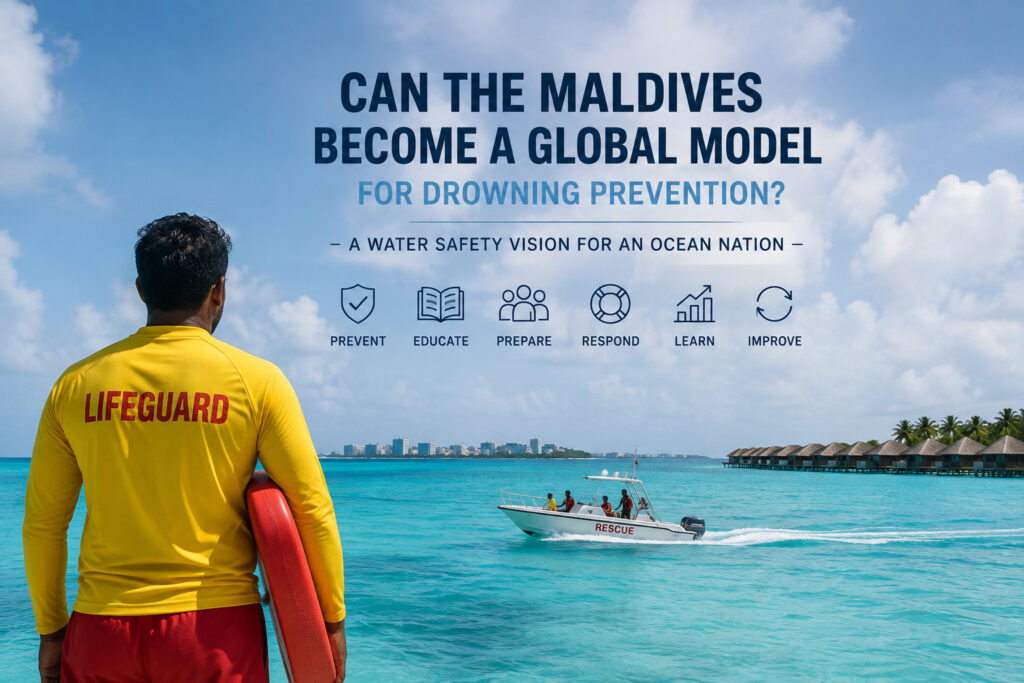
Can the Maldives become a global example of how drowning can be prevented?
Drowning Is Preventable
Drowning remains a significant global public-health challenge, with approximately 300,000 deaths reported worldwide each year. The World Health Organization emphasizes that drowning is preventable through coordinated action involving education, safer environments, rescue and resuscitation, transport safety, preparedness and effective policies.
For the Maldives, this message is particularly relevant.
Water is part of daily life. Beaches, lagoons, swimming pools, marine transportation, fishing, watersports and tourism all create different aquatic environments and risks.
Therefore, water safety cannot depend on lifeguards or rescue teams alone.
It requires a culture of prevention.
From Rescue to Prevention
A strong water-safety system begins before an emergency occurs.
Risk assessment, public awareness, competent supervision, emergency preparedness, rescue capability, resuscitation and effective incident learning must work together.
The objective is not simply to respond faster.
The objective is to prevent the emergency from occurring in the first place.
An Opportunity for the Maldives
Drowning prevention requires collaboration across public health, education, tourism, maritime transport, emergency services, local communities and other sectors.
In July 2026, the World Health Organization reported that Maldives had begun work toward a national strategy for preventing unintentional injuries, with drowning and maritime injuries identified as priority areas.
This presents an important opportunity to strengthen national water-safety efforts through education, community preparedness, professional rescue capability, better data, safer aquatic environments and coordinated action.
A Vision for an Ocean Nation
The Maldives does not need to replicate another country’s approach.
Its geography and relationship with water are unique.
The country has the opportunity to develop a Maldives-specific water-safety model that combines prevention, education, preparedness, rescue, data and continuous improvement.
The Maldives is surrounded by water.
It can also become a nation surrounded by water-safety knowledge.
The Maldives Swimming and Life Saving Skills Training School (MSLSTS) believes that water safety is more than a rescue function. It is a shared responsibility built on prevention, competency, preparedness, evidence and continuous improvement.
As an ocean nation, the Maldives has an opportunity not only to protect lives at home, but also to contribute meaningful experience to the global movement for drowning prevention.
