The Hybrid Model: Building the Lifeguarding System the Maldives Did Not Have
No written lifeguarding system exists for Maldivian conditions. A certificate qualifies the lifeguard; nothing supplies the system around them. At Sun Siyam Iru Veli, we had to build that part ourselves, out of almost nothing.
By Ahmed Jamsheed
SAFETY AND SECURITY MANAGER · SUN SIYAM IRU VELI, DHAALU ATOLL
Our lifeguarding operation began with a near-drowning on an otherwise unremarkable afternoon in 2024. A guest waded out from the shallows, carried on walking, and found themselves in deep water. Help happened to be close at hand, and that is the only reason I am writing about a near-drowning rather than a drowning. The guest recovered after minor treatment at our resort clinic.
That outcome ought to have been reassuring. It was not. What it told me was that we had been saved by proximity rather than by design, and proximity is not a control measure.
The Standard That Did Not Exist
International standards do exist, and they are sound standards. But they were written for other water. Read them closely and you will notice that none of the environments they describe is ours. We are not a swimming pool. We are not an inland lake. We are not a patrolled surf beach with a flag line and an ambulance twenty minutes down the road. We are a lagoon and a house reef in an atoll, with currents that reverse between monsoons, guests snorkelling unsupervised over a drop-off because that is precisely what they have paid for, and a seaplane as the nearest escalation.
More to the point, a certificate qualifies a person. It does not hand you a system. Nowhere could I find a written lifeguarding system, tailored to Maldivian conditions and ready to implement in a Maldivian resort. There was no document to adopt, no model to localise, no precedent to argue with. Time is a luxury we did not have, so I built one.
Reading the Water
What I drew on came from my previous career in the Maldives Police Service. Vigilant patrolling and reactive response management are not hospitality disciplines; they are policing disciplines, and I had spent years practising both. The first work was survey work. We established where guests gather to swim and snorkel, where activity concentrates and where the current runs hardest, then learned how those patterns shift with the monsoon. Hazards were managed rather than merely noted. Beach flags went where they would be seen, sited against guest sightlines and footfall rather than against a site plan. Zones followed, and patrolling patterns after them. Most importantly, we set standards: what a lifeguard does in fair weather, and what changes the moment the sea gets up. Surveillance standards covered a guest from entry to safe exit, with identification and communication methods to match.
Planning For the Resources You Actually Have
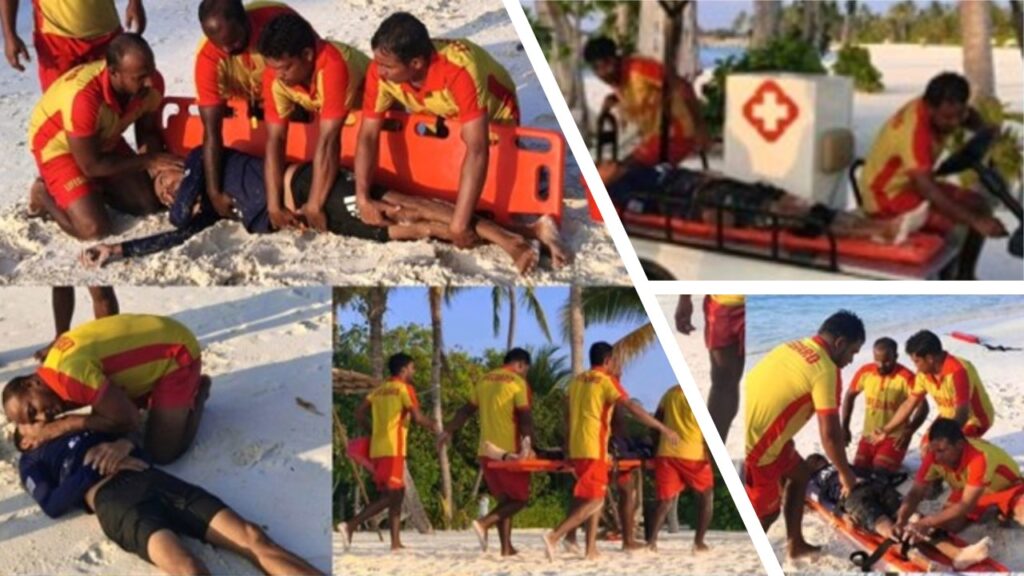
The reactive half came next. We built a response framework, tested it, refined it, and only then trained the lifeguards and every other role with a part to play in the critical phase. The incident management framework came next, and here the remoteness of an island resort forces an honest reckoning. Whatever capability exists on the island at the time of an incident is the whole of the capability available. A plan calibrated to the resources in your hand performs under pressure. A plan calibrated to ideal resources fails at the exact moment it is needed.
Survivability in drowning is governed by how quickly resuscitation begins, and every second of that window goes on communication, task allocation and clarity of individual action. Drill those and you buy minutes. Leave them to the day and you lose them.
The same discipline was extended to programmed water activities, pool parties, where the risk profile differs sharply from open water. Introduce a complication and the vigilance method changes with it. Foam is the clearest example. Once a guest disappears into thick foam, we count from that second, and the clock rules out distress and drowning before anything else is assumed. Small activities in a confined area get a total coverage methodology. Where more than one lifeguard is on active surveillance, an emergency backup methodology ensures a response never comes at the cost of the scan.
Equipment followed the same logic. Not the full inventory, but a lean list, just enough to stand the system up without landing the resort with an unbudgeted bill, then a phased plan to bring the team to full kit. A system that costs too much at the outset does not get built at all.
The Part Nobody Writes Down
Embedding all of this into a luxury environment proved harder than any of it, because it runs against the grain of the industry. Follow in someone else’s footsteps and you arrive where they already are. Going elsewhere takes a tolerance for decisions whose mistakes are expensive, and a habit I would recommend to anyone working front of house: plan the recovery before you need it, so a misstep is corrected before it ever reaches a guest.
Through that phase I tested every guest interaction against the only metric that mattered, which was the guest’s face. Not a survey, not a score, but the expression in front of me at the time of contact. Is this working? Does the guest appreciate it? Slowly and deliberately, I tailored each interaction and kept adding to it. Our greeting is the plainest example: it began as a greeting standard, became the art of greeting, and has since evolved into what I call the tapestry of greetings. I have not itemised these interactions, because they were made for Sun Siyam Iru Veli, and I would like them to stay that way.
Counting the Wrong Number
Then there is the question everyone asks first: how many lifeguards do you need? Everyone reaches for the standard ratio, and to my mind that ratio is applied to the wrong number. Not full guest capacity, not bed count, but the proportion of guests who will be in the water. Judged that way, one lifeguard is enough to begin, provided the security officers are trained alongside them as a second layer, genuinely capable of scanning water rather than standing near it. You size the team against the resources you can stretch into lifeguarding.
Sizing it that way is also what lets it grow. We began with one lifeguard and now extend cover to excursions, snorkelling safaris included, without a single additional headcount, by training and certifying the boat crews as lifeguards. The crew were going to be aboard in any case. Change the system and that same crew is watching the water, with one of them in it, guiding the snorkellers and watching the weaker swimmers. Nothing was added but capability. Every resort in the country already owns this resource and almost none use it, which is a large part of why Sun Siyam Iru Veli stands apart from the sea of uniformity.
Building a Team, You Cannot Recruit
The arrival of Mr Ahmed Shifau as Safety and Security Supervisor changed the pace of all of it. We had worked together at another property, where I had talked through where lifeguarding in the Maldives had to modernise, so he arrived already understanding the goal. Having someone alongside me who shared it was no small thing. He took the weekly training, monitored the system daily and retrained every lifeguard against the redefined standards, freeing me to keep working on the standards themselves. His own recognition followed: the Supervisor Excellence Award in Water Safety Integration and a Level 1 swimming and water rescue instructor licence.
Recruitment told its own story. We hired our first dedicated lifeguard, Mr Mohamed Farhood, in 2024 and began active guest surveillance along the waterfronts. The need for a second became obvious almost immediately, and conventional channels produced nobody. The one candidate who applied was a seventeen-year-old, Mr Hassan Yousuf Adam Abbas, and he could not swim. We trained him anyway, Farhood and I between us, on a schedule that was never easy and never physically light. Yousuf never once gave up. He learned to swim, completed lifeguard training, and certified in full. Guests now name him regularly on TripAdvisor, praising his service and, as often as not, calling him a friend. That is Maldivian hospitality doing what it does best.
Multiplying the Eyes on the Water
The last layer costs almost nothing, and I would put it at the top of any resort’s list. Staff working the overwater villas, jetties and outlets already stand above the water for most of their shift. Train them to recognise drowning and distress, which rarely looks like the thrashing everyone expects and is precisely why it goes unseen, and the eyes on the water multiply without a single additional post. Eighty per cent of our staff have now completed water safety awareness training, and our relief layer is drawn from security officers, boat crews and other departments, all licensed by the Maldives Swimming and Life Saving Skills Training School. Practically every resort in the country has overwater villas, jetties, and outlets. If the industry did this and nothing else, the water around these islands would be measurably safer.
This hybrid model balances proactive lifeguarding, reactive emergency response and luxury hospitality. It was recognised at the 3rd Life Saving Leadership Awards Ceremony on 17 May 2026, where Sun Siyam Iru Veli received Water Safety Excellence Award 2025, The Pinnacle Resort Award 2025, Best Lifeguard Service Operation Award 2025, the Sustainability in Lifeguard Operation Award 2025 and the Water Safety Education and Advocacy Award 2025.
The awards are welcome. The point, though, sits elsewhere. Standing out from the sea of uniformity is not a matter of outspending the resort next door. It is a matter of building something the industry has not yet thought to build, out of the resources already sitting on your island. This standard did not come off a shelf, because there was no shelf. We started with one near-miss and nothing written down. Everything after that was a decision.
About the Author
Ahmed Jamsheed is the Safety and Security Manager at Sun Siyam Iru Veli and a certified Level 1 Swimming and Water Rescue Instructor. A Guardian of Ocean Safety Ambassador for 2026, he is the recipient of the Trident Excellence Award for Lifesaving Skills Service Recognition, 2025 and was named Security Officer of the Year at the Hotelier Maldives Awards 2025.
