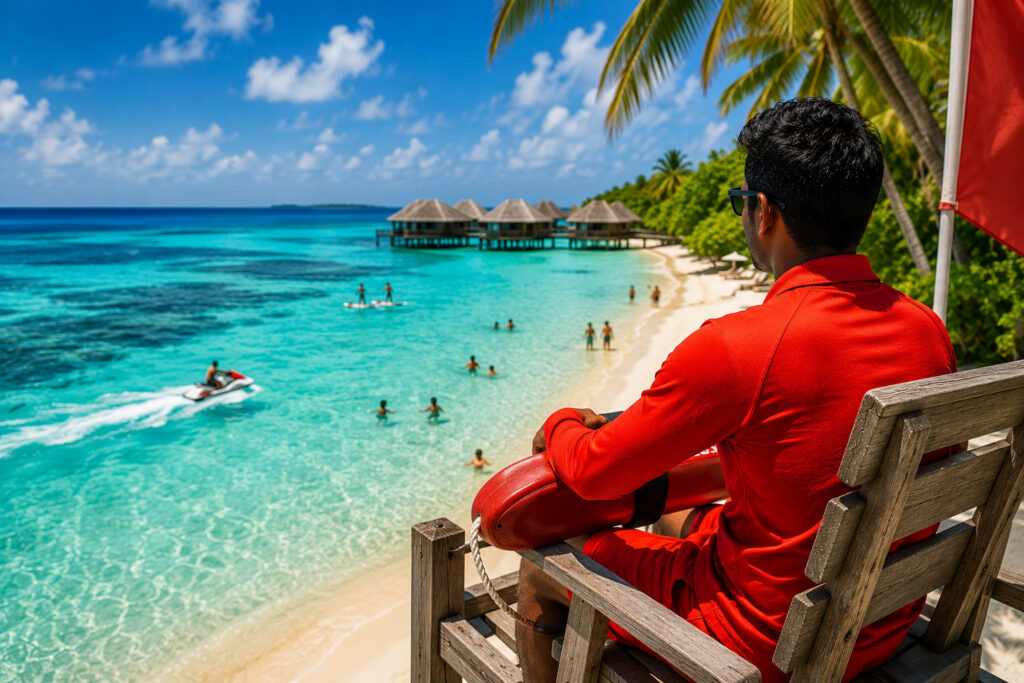
In the Maldives, water safety is directly connected to tourism safety. A resort, hotel or guesthouse may offer beautiful beaches, swimming pools, lagoons, diving, snorkelling and water-sports activities, but every activity involving water carries responsibility.
The Maldives’ Safety and Security Standards at Tourist Establishments already recognise this responsibility. The regulation requires tourist establishments to provide safety briefings to guests, maintain emergency communication arrangements, provide life jackets and life buoys at specified locations, and deploy lifeguards at designated swimming areas, common swimming pools and designated water-sports areas during operating hours.
These requirements should not be viewed simply as regulatory obligations. They represent the minimum foundation of a responsible water-safety system.
A strong establishment should know its aquatic risks before an emergency occurs. It should understand where guests are swimming, what environmental conditions can change, where visibility may be limited, what rescue equipment is available, how an emergency will be communicated and who is responsible for the first response.
A lifeguard alone is not a water-safety system.
Effective water safety requires the right combination of trained personnel, active surveillance, risk assessment, rescue equipment, emergency procedures, communication, first-aid capability and continuous competency.
This is particularly important in the Maldives because aquatic environments are not static. Weather, wind, waves, currents, tides, visibility and guest behaviour can change during the same operating period. A safety arrangement that is appropriate in the morning may require reassessment later in the day.
The responsibility also extends beyond resort islands. The Ministry of Tourism has previously conducted water-safety work involving island councils, guesthouse operators, water-sports centres, the Maldives Police Service and the Maldives Coast Guard, recognising the need for practical water-safety measures in inhabited islands.
For guesthouses and local tourism establishments, this is particularly important. Visitors may enter surrounding beaches and lagoons without understanding local conditions. Guest safety therefore requires appropriate information, supervision, emergency arrangements and coordination with competent local responders.
The Maldives’ tourism industry should therefore move beyond the question of “Do we have a lifeguard?”
The better question is:
“Can we demonstrate that our entire aquatic environment is being managed safely?”
That is the standard that protects guests, protects employees, strengthens tourism operations and, most importantly, protects life.
Water safety should not begin when someone is drowning.
It should begin before anyone enters the water.
