
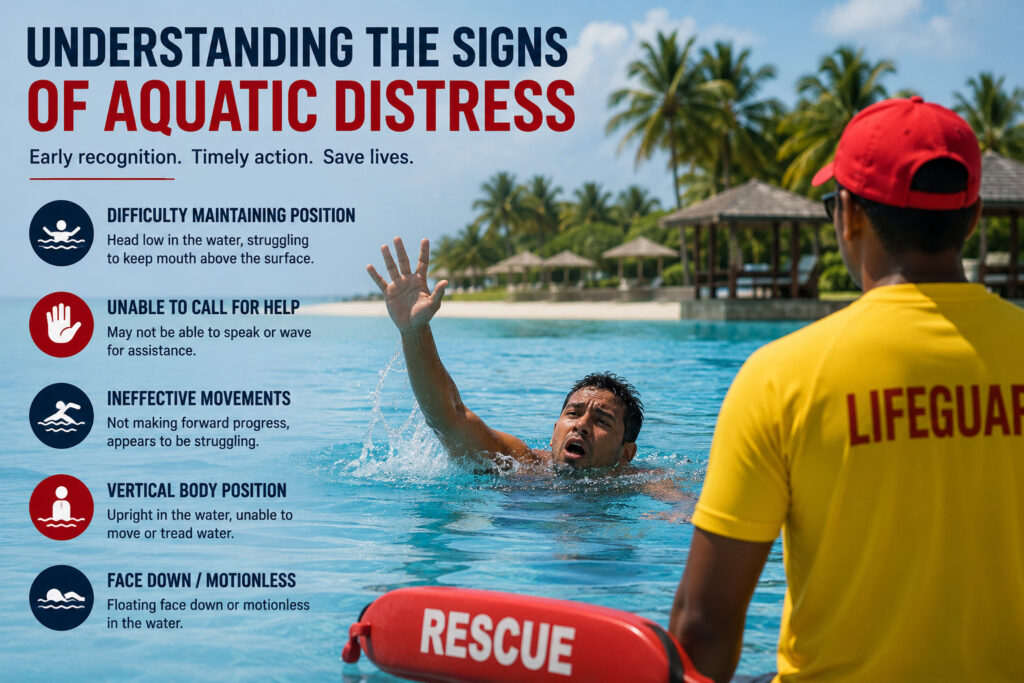
Recognising a person in difficulty is one of the most important elements of drowning prevention. The ability to identify deteriorating behaviour early creates an opportunity to intervene before respiratory impairment becomes severe.
The World Health Organization defines drowning as the process of experiencing respiratory impairment from immersion or submersion in liquid. This matters because drowning is a process, not a single moment when a person disappears underwater — and it can end in death, illness, or complete recovery.
What Is Aquatic Distress?
Aquatic distress describes a situation in which a person is struggling to maintain safety in the water and may need assistance.
A person’s ability to cope varies widely. One individual may remain conscious and capable of purposeful movement, while another may be progressing toward drowning and losing the ability to protect their airway or stay afloat. Recognition should therefore focus on observable changes in behaviour and capability, not on waiting for an obviously dramatic rescue situation.
Key indicators to watch for:
- Difficulty maintaining a safe position in the water
- Little or no effective forward movement
- Repeated, unsuccessful attempts to regain control
- Increasing difficulty keeping the airway clear
- Sudden deterioration in previously effective swimming
- Unusual stillness or reduced responsiveness
- A person motionless and face-down in the water
- No single visual cue is a reliable, standalone test for drowning.
Drowning Is Primarily a Respiratory Problem
A common misconception is that drowning is defined by swallowing water or by how much water enters the lungs. In fact, the defining feature is respiratory impairment caused by immersion or submersion.
As that impairment develops, a person’s ability to communicate, coordinate movement, and hold an effective swimming position deteriorates. This is why observing breathing, body position, purposeful movement, and responsiveness tells you far more than watching for dramatic splashing.
Why a Person May Not Call for Help
Communication takes attention and physical capability. Someone struggling to keep their airway clear may have little capacity left to speak, signal, or deliberately attract attention while also trying to breathe and stay above the surface.
The absence of a call for help should never be read as evidence that a swimmer is safe.
Research on lifeguard surveillance confirms that recognising drowning is a genuinely demanding perceptual task — detection performance is shaped by observer experience, environmental conditions, the number of bathers present, and how long the event has been unfolding.
Recognition Is More Than Watching the Water
Effective aquatic surveillance means interpreting change, not just looking at people. A competent observer continually assesses whether behaviour matches normal swimming, and whether a person’s movement, position, or responsiveness has shifted.
Studies of lifeguard performance show that the ability to pick out relevant visual cues is directly linked to faster, more timely detection of drowning events. The underlying principle: good surveillance is an active process of observation and interpretation — not passive watching.
Distress Can Progress to Drowning
Aquatic distress and drowning are not interchangeable terms. A person may initially be struggling yet still able to breathe and move purposefully. Once their ability to protect the airway and breathe becomes impaired, the situation has progressed into the drowning process itself.
The internationally accepted definition centres on this respiratory impairment — not on whether someone looks frightened, swallows water, or goes fully underwater. Early recognition is what creates the window for prevention.
What Research Shows About Lifeguard Intervention
Evidence from operational lifeguard services shows that prevention and early intervention make up the bulk of lifeguarding work. One large observational study of a lifeguarded beach logged more than 1.5 million lifeguard actions — the overwhelming majority were preventative. Recognising people in stress or distress and carrying out rescues formed a much smaller share of activity, and only a small fraction of rescues required respiratory support or CPR.
The lesson: effective lifeguarding isn’t measured by dramatic rescues alone. Its greatest value lies in spotting risk and acting before a situation turns life-threatening.
The Importance of Continuous Surveillance
Drowning recognition is difficult even for trained professionals. Detection performance is affected by how many people are in the water, how long the event has been developing, and how long an observer has been on watch. Experienced lifeguards generally outperform less experienced observers — but surveillance remains a demanding task regardless of experience.
Aquatic safety systems should therefore account for more than individual competence, including:
– Surveillance conditions and zone coverage
– Workload and rotation
– Environmental visibility
Positioning
– Operational procedures
– The Essential Knowledge
A person in aquatic distress doesn’t behave in one predictable way — there is no single visual pattern that identifies every drowning event. The safest approach is to watch for changes from normal behaviour across five dimensions:
Position — Movement — Breathing — Progress — Responsiveness
When a person’s ability to stay safe in the water is deteriorating, early intervention can prevent the situation from becoming a more serious emergency.
Recognise the change. Assess the risk. Act early.
Drowning prevention begins before a person is submerged and continues through effective surveillance, timely recognition, safe rescue, and appropriate care. For professionals responsible for aquatic safety, recognising subtle changes isn’t just a useful skill — it’s a fundamental component of drowning prevention.
MSLSTS Perspective
The Maldives Swimming and Life Saving Skills Training School (MSLSTS) promotes evidence-based water-safety education, treating prevention, observation, professional judgement, and timely intervention as essential elements of aquatic safety. Understanding what distress looks like — and recognising when normal swimming behaviour begins to change — is one of the foundations of effective water-safety practice.
