
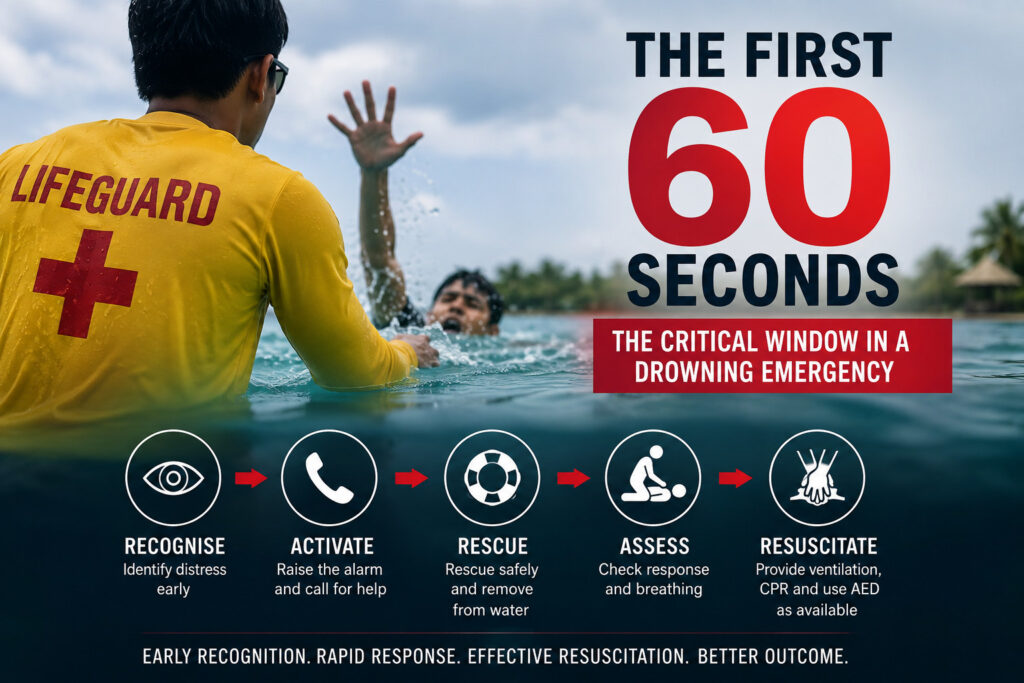
The importance of the first minute in drowning is based on human physiology, not a fixed “60-second rule.” Drowning causes respiratory impairment. When effective breathing is lost, oxygen levels in the blood fall, causing hypoxaemia and tissue hypoxia. The brain is particularly vulnerable to oxygen deprivation. Prolonged hypoxia can lead to loss of consciousness, cardiac arrest, neurological injury and death.
How Should a Lifeguard Act?
A professional lifeguard must convert recognition into immediate action:
1. RECOGNISE
Identify signs of drowning early. Do not wait for a person to wave, shout or call for help.
2. ACTIVATE
Raise the alarm immediately and direct another person to activate the emergency medical response and bring rescue equipment/AED.
3. RESCUE SAFELY
Enter the water only according to the lifeguard’s training and conditions. Use appropriate rescue equipment whenever possible. The rescuer must avoid becoming a second casualty.
4. REMOVE & ASSESS
Bring the casualty to a safe location and rapidly assess responsiveness and breathing.
5. RESUSCITATE
If the casualty is not breathing normally, begin appropriate drowning resuscitation without unnecessary delay. For trained responders, ventilation is particularly important in drowning, because oxygen deprivation is central to the pathophysiology. CPR and an AED should be used according to current training and protocols.
The Scientific Principle
Drowning → respiratory impairment → hypoxia → loss of consciousness → cardiac arrest → neurological injury/death
A lifeguard’s objective is to interrupt this sequence as early as possible.
Therefore, the “first 60 seconds” should be understood as a critical operational window: not a precise biological deadline, but a period in which rapid recognition, coordinated rescue and effective resuscitation can prevent the progression of hypoxia.
For a lifeguard, the first intervention is not CPR—it is recognising the drowning process early enough to prevent the casualty from reaching cardiac arrest.
