Lifeguarding: The Missing Standard in Maldivian Luxury Hospitality
Sun, pristine beaches, and house reefs teeming with marine life: these are the images that sell the Maldives, a destination synonymous with luxury hospitality. Every brochure, every campaign and every guest expectation are built upon the water. Yet on these small paradise islands, our greatest assets are also our greatest risks. The very lagoons and reefs that draw guests from across the world are the same waters in which a life can be lost in seconds. A promise of luxury that does not include a promise of safety is an incomplete promise.
Water safety remains the least standardised area of resort operations in the Maldives. To its credit, the country took a significant step in 2020, when lifeguarding became a statutory requirement — something many destinations, including far larger tourism economies, still lack. The regulations exist, the intent is sound, and the foundation is firmly in place. What is missing is the refinement needed to bring these standards in line with the expectations of modern luxury hospitality, and with the realities of how drownings occur.
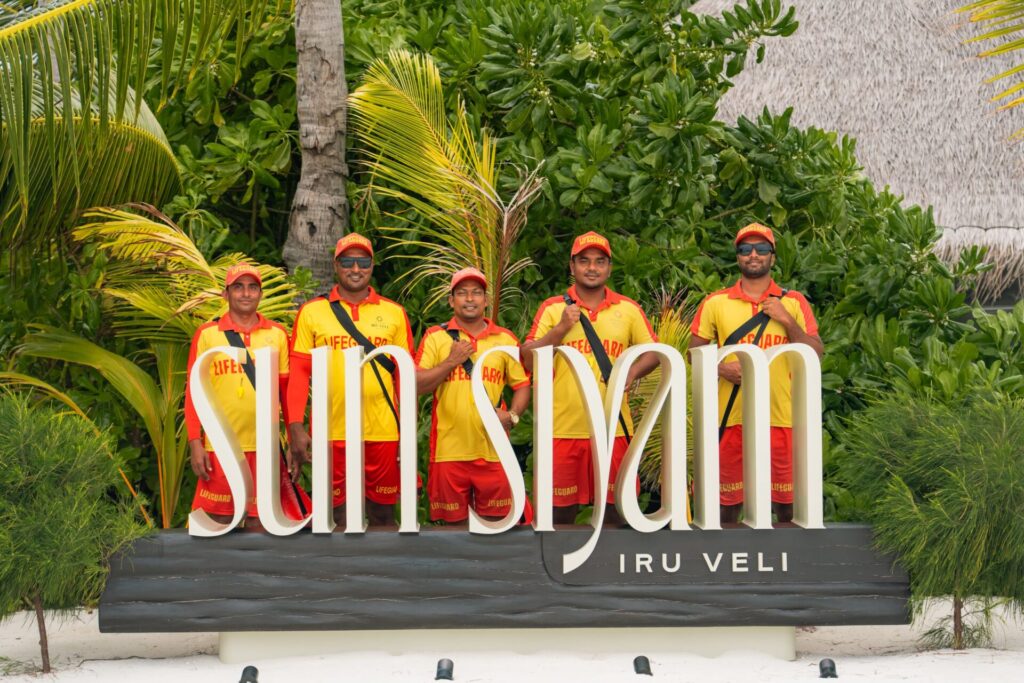
The gap is simple to describe. While the law requires lifeguards, it does not require them to be dedicated lifeguards. A receptionist or a water sports instructor who holds a lifeguard qualification satisfies the statutory requirement, even though their attention belongs, for most of the working day, to another job entirely. In practice, this dual tasking creates precisely what international lifesaving standards warn against: distraction. Drowning is rarely the dramatic, splashing spectacle of film; it is fast, quiet, and easily missed. The few seconds in which a dual-tasked employee turns to answer a telephone, complete a booking, or rig a sail leave the water unwatched, and unwatched water is where drownings happen. Therefore, leading international standards actively discourage assigning secondary duties to anyone responsible for water surveillance. The regulations also mandate rescue equipment, such as life rings placed on hooks along the shoreline. This equipment matters, but a life ring cannot save a drowning victim on its own. It has no eyes or ears to spot a guest in difficulty, and no arms or legs to swim out and bring them safely back to shore. Equipment saves lives only in trained hands. Only a professional, dedicated lifeguard — scanning the water continuously, positioned with clear sightlines and free of competing duties — can recognise the early signs of distress and respond before distress becomes tragedy.
There is also a commercial truth here that the industry cannot afford to ignore. Luxury hospitality is defined by anticipating a guest’s needs before the guest has voiced them, and no need is more fundamental than the need to be safe. A trained professional watching over the water is not an operational cost; it is service in its purest form, and discerning guests notice it. Equally, a single drowning travels around the world faster than any marketing campaign, carrying with it questions of duty of care, liability, and reputation. Prevention is not merely the ethical position; it is the sound business position.
The solution does not require building a system from scratch. The Maldives already operates a safety inspection framework, complete with penalties for non-compliance. Lifeguarding is simply absent from it. Embedding lifeguarding within that existing framework would close the loop: defining the lifeguard as a dedicated role, setting active surveillance, effective scanning, victim recognition, vigilance patrolling, area of responsibility, zoning methodology, and requiring regular requalification. Once written into the inspection regime, these standards would become a living benchmark — inspected, enforced, and continuously upheld, rather than left to interpretation. That is a sustainable approach to safety, and a safe destination is, by definition, a sustainable one.
Embedding the standard would also elevate the profession itself. When lifeguarding is treated as a dedicated career rather than an add-on qualification, it attracts investment in training, creates progression for Maldivian professionals and gives resorts a genuine point of distinction. The properties that move first will not simply be complying with a regulation; they will be setting the benchmark the rest of the industry follows. Being one of the world’s most celebrated destinations is not enough; sustaining that reputation is what matters. We will not elevate the Maldives by carrying on as we are, trusting that paradise polices itself. We will do it by confronting our risks honestly and redefining our standards, so that professional, dedicated lifeguarding sits at the heart of luxury hospitality — where it has always belonged.
About the Author
Ahmed Jamsheed is the Safety and Security Manager at Sun Siyam Iru Veli and a certified Level 1 Swimming and Water Rescue Instructor. A Guardian of Ocean Safety Ambassador for 2026, he is the recipient of the Trident Excellence Award for Lifesaving Skills Service Recognition, 2025 and was named Security Officer of the Year at the Hotelier Maldives Awards 2025.
